
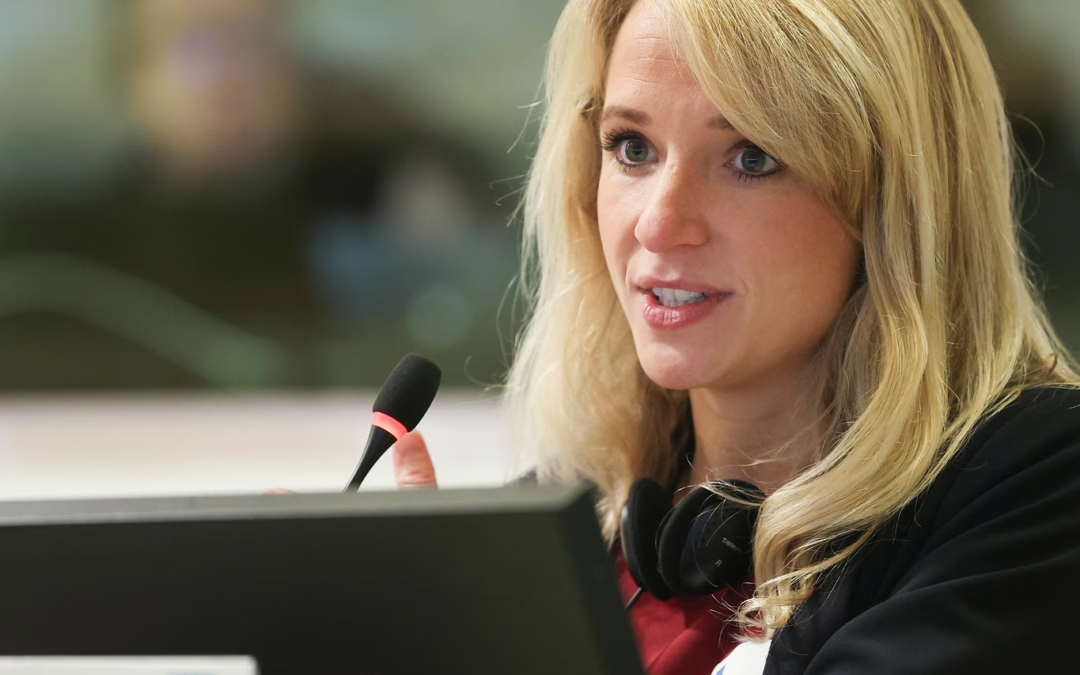
You know your brief inside out. You have years of expertise. You can navigate the most complex dossier in your sleep. And yet — you stand at the microphone, or sit on a panel at a Council event, and something gets lost. The message doesn’t land the way it should. The room doesn’t follow. The conversation moves on without your point being truly heard.
This experience is more common than most EU professionals admit. And it has nothing to do with intelligence, expertise, or commitment. It has everything to do with a set of skills that most institutions never teach — and rarely invest in.
This article is for policy makers, senior officials, and professionals working in European institutions and organisations who want their voice to actually move things. Not just to inform, but to persuade, to inspire, to lead.
Why Communication Skills Are a Leadership Issue in Brussels
In the European institutional context, communication is inseparable from influence. Coalitions are built in corridors and at panel tables. Directives live or die on the quality of the argument made in the room. Political will is shaped by the people who can articulate why something matters — not just that it does.
And yet, public speaking and facilitation skills are almost never part of formal career development in EU institutions. The assumption is that expertise speaks for itself. It doesn’t.
The best prepared person in the room is not always the most heard. The most heard person is usually the clearest, most present, and most human.
What follows are six practical principles I’ve developed through years of coaching EU officials, Members of the European Parliament, and policy professionals across European organisations — as well as from my own experience moderating high-level dialogues at the European Commission, the European Parliament, and major sustainability and innovation summits.
1. Know Your Intention Before You Know Your Content
Before you think about what you’re going to say, ask yourself: what do you want to happen? Not what do you want to report, but what shift are you trying to create — in understanding, in emotion, in commitment?
This sounds obvious, but in practice most EU presentations are structured around information transfer: here is what I know, here is the policy context, here are the next steps. That structure produces presentations that are accurate and forgettable.
Impact-driven speaking starts with a different question: what is the one thing I want this audience to feel, think, or do differently after I’ve spoken? Write that down before you write a single slide or talking point. It becomes your compass — and anything that doesn’t serve it, cuts.
2. Listen Before You Speak — Even in High-Stakes Settings
One of the most undervalued communication skills in policy environments is deep listening. Not waiting for your turn to speak, but genuinely attending to what’s in the room: the concerns being voiced, the tensions left unsaid, the question underneath the question.
In panel discussions and stakeholder dialogues — formats I work with constantly — the officials who make the strongest impression are rarely those who speak the most. They’re the ones who respond to what was actually said, who build on others‘ contributions, who show they were present enough to be changed by the conversation.
Before your next panel or plenary intervention: spend five minutes genuinely mapping what your audience is likely bringing into the room. What are their fears, their frustrations, their hopes around this topic? Attune yourself to that context before you decide what to say — and how.
3. Speak in Stories, Not Just Policy Language
Policy language does what it’s designed to do: it is precise, defensible, and consistent. It is also, frequently, completely impenetrable to anyone outside the bubble — and even to many inside it.
Neuroscience is clear on this point: stories activate far more regions of the brain than abstract information. They create identification, emotional resonance, and memorability. A ‚just transition‘ becomes real when you talk about the coal worker in a region you visited. ‚Food system resilience‘ lands differently when you describe a farmer who couldn’t get crop insurance. The principle doesn’t change; the human face of it does.
This doesn’t mean abandoning rigour. It means anchoring your technical points in moments that make them tangible. One well-chosen story, told briefly and specifically, does more for your argument than three additional slides of data.
4. Use Your Body — Especially in Multilingual Rooms
In the European institutional context, most communication happens in rooms where speakers and audiences are not using their first, or even second, language. This makes non-verbal communication far more important than most professionals realise.
Research consistently shows that over half of how a message is received comes from body language and tone — not the words themselves. In a multilingual room, that proportion almost certainly rises. When the words are technically demanding, presence, posture, and energy carry the meaning.
Practical tips for in-person and hybrid EU events:
- Stand whenever possible — even on video calls. It opens your breathing, improves vocal resonance, and projects a sense of authority and groundedness.
- Use deliberate gestures. In large or hybrid rooms, amplify your natural gestural range rather than suppressing it. What feels exaggerated to you often reads as appropriate energy to an audience.
- Pace yourself consciously. EU policy language tends toward speed and density. Slow down. Pause after key points. The silence is not dead air — it’s the moment when meaning settles.
- Make eye contact broadly. In panels, resist the habit of looking only at the moderator or the chair. Speak to the room.
5. Manage Interruptions — Especially as a Woman in Institutional Settings
Interruptions in high-level policy settings are not random. They follow power dynamics, and women and junior officials are disproportionately affected. This is a structural issue, not a personal one — but it has personal consequences for how you’re heard and how your contributions are weighted.
A few approaches that work:
- Structure your contributions with a clear opening signal: ‚I want to make three points on this.‘ It creates a frame that makes interruption feel rude rather than natural.
- End your sentences firmly — voice going down, not up. Trailing upward inflections signal uncertainty and invite takeover.
- If interrupted, stay calm and continue: ‚I’d like to finish this point‘ is enough. You don’t need to argue for your right to speak; you simply exercise it.
- If someone else is interrupted, name it: ‚I’d like to hear [name] finish their thought.‘ Collective accountability in rooms changes the dynamic faster than individual resilience alone.
6. Prepare Your State, Not Just Your Slides
One of the most consistent findings in my communication coaching is that how you show up — your energy, your presence, your emotional state — matters as much as what you’ve prepared to say.
This is especially true for high-stakes EU speaking moments: plenary interventions, press briefings, panel discussions with Ministers or Commissioners present. When the stakes rise, the nervous system responds. Preparation that only covers content leaves you exposed to that response.
Build a pre-speaking ritual. In the fifteen minutes before any significant speaking moment, consciously shift your state. Move your body — walk, stretch, shake out tension. Recall why this topic matters to you personally. Set a clear intention for the room you’re about to enter. This kind of preparation is not soft; it’s what separates competent speakers from genuinely memorable ones.
Ready to make your voice count?
Get your free guide now and start turning conversations into catalysts.
👉 Download your guide.
🧠 Step into your power.
🌍 Speak for the future.
The Biggest Mistake EU Professionals Make with Public Speaking
It’s this: waiting until they feel ready.
In almost every coaching conversation I have with policy professionals, there’s a version of this sentence: ‚I want to work on my speaking, but I’m waiting for the right opportunity / the right moment / until this dossier is closed / until I’m a bit more senior.‘
But speaking skills develop through doing — and through doing with reflection and feedback. The officials who communicate most powerfully in Brussels are not those who were born with it. They’re the ones who took it seriously as a professional competence early, and invested in developing it deliberately.
Waiting doesn’t get you closer to readiness. It just means the next important speaking moment will find you less prepared than you could have been.
Working with a Speaking Coach in a European Context
Coaching for EU communication is a specific discipline. It’s not the same as general presentation skills training. The contexts are different — technically complex topics, multilingual audiences, high institutional stakes, specific formats like trilogues, committee hearings, or stakeholder dialogues. The dynamics of power and seniority are different. And the outcomes — coalition-building, mandate-shaping, narrative-setting — are different.
At the Merle Academy in Brussels, all coaching programmes are designed for professionals working in exactly these environments. Whether you need focused preparation for a specific speaking moment or longer-term development of your presence and impact, programmes are available in English, German, and French — in person and online.
Find out more: merle.community/public-speaking-academy
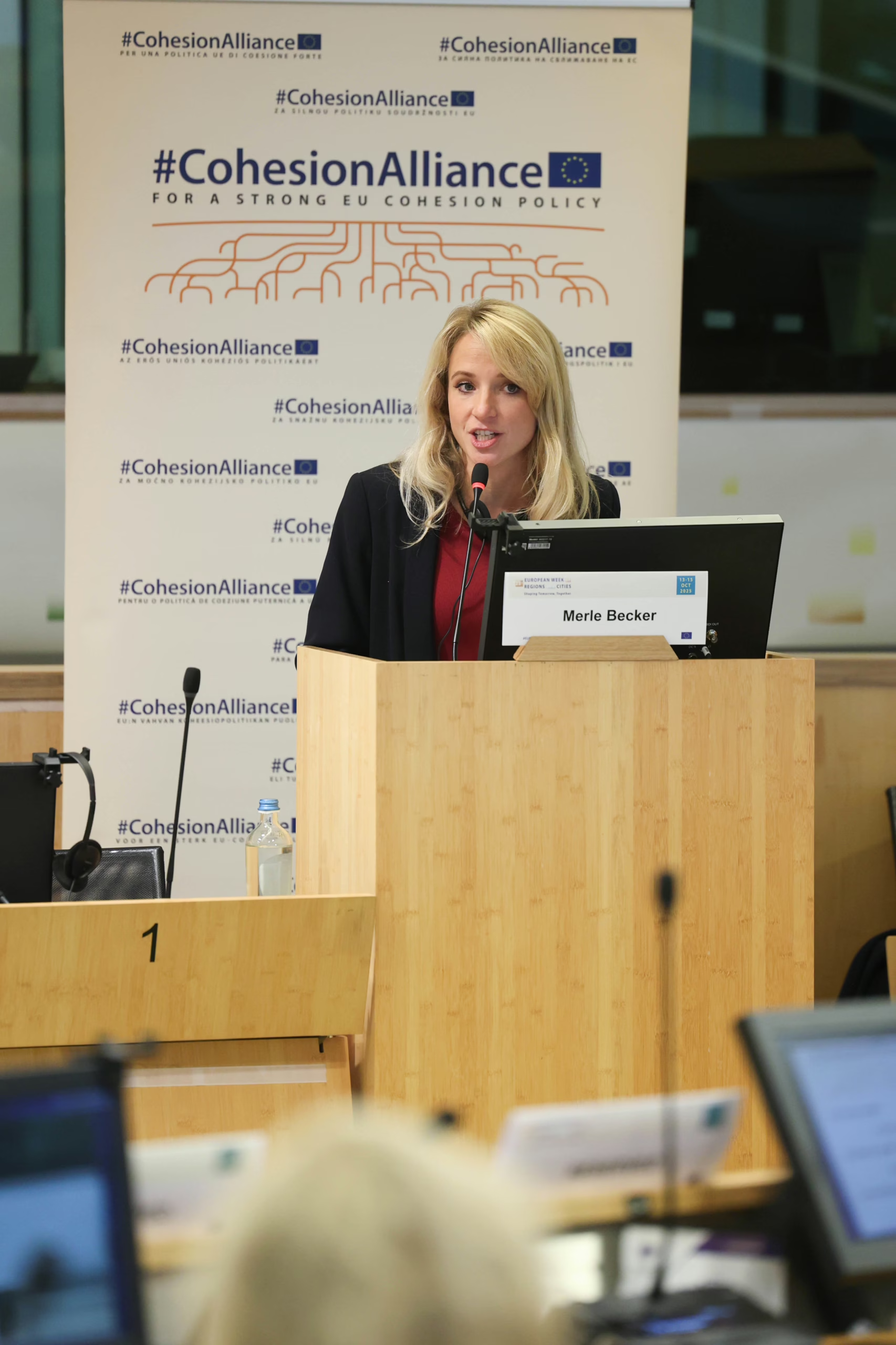
Merle Becker is a multilingual moderator and speaking coach based in Brussels.
She works with EU institutions, international organisations, and European civil society — moderating high-level panels and coaching professionals who want to speak with more clarity, presence, and impact.
She is the founder of Merle.Community, a Brussels-based speaker agency and coaching practice.